PL-03 · Analytics · Enterprise IT
Data science pipeline automation
An automated, governed data pipeline that cut preprocessing from days to hours for reporting and ML.
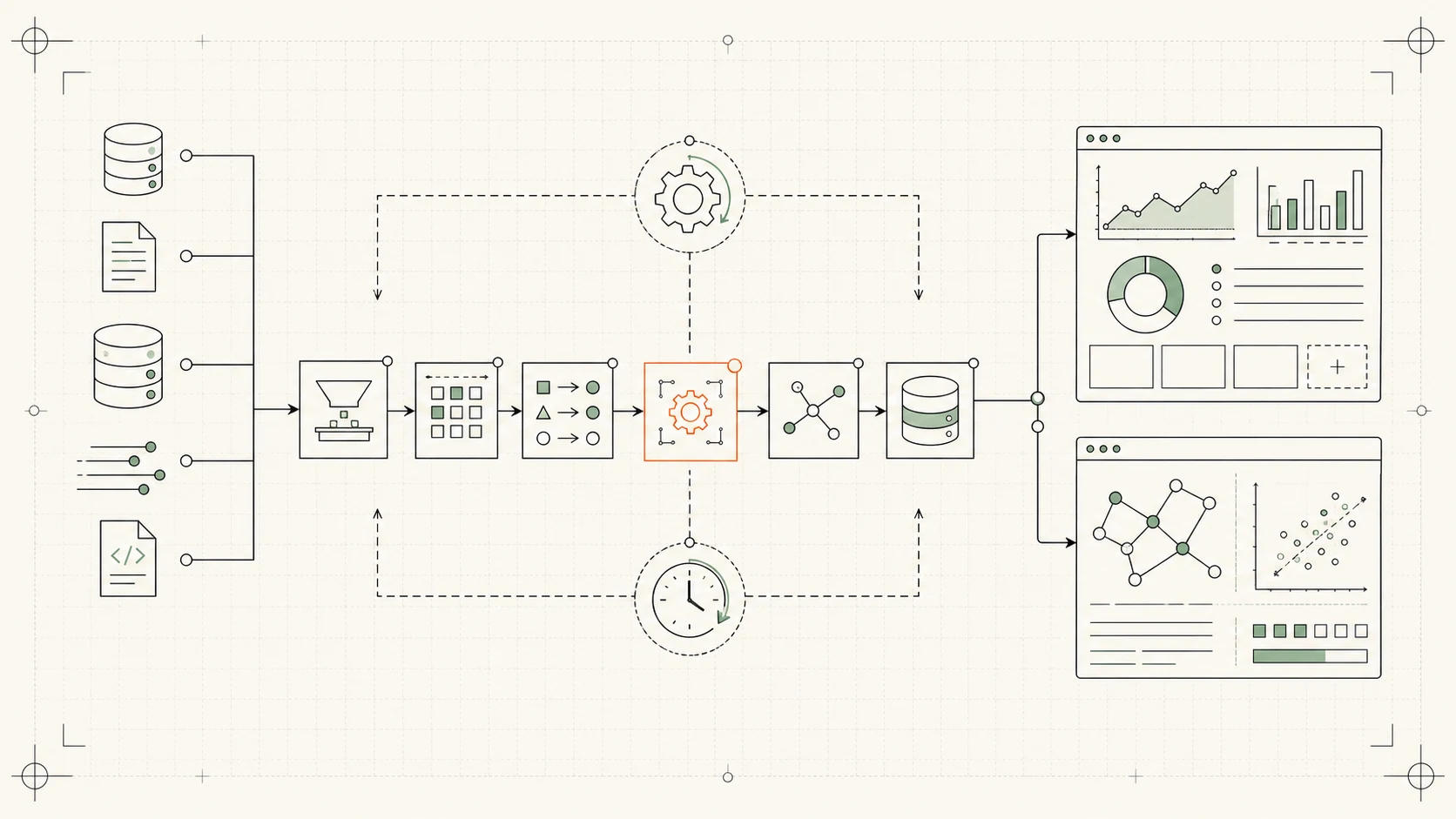
We partnered with the analytics and enterprise IT teams of a global organisation to design and implement an automated data pipeline supporting advanced reporting and machine-learning workflows. The objective was to streamline data operations — from ingestion and transformation to delivery — across multiple sources, replacing fragmented manual processes with a scalable, repeatable solution.
The pipeline was built with modularity and governance in mind, ensuring consistent preprocessing logic, robust logging, and traceability throughout. Custom CLI tools and scheduling components supported a variety of analytical use cases, from daily reports to on-demand data-science experiments. This automation significantly accelerated insights delivery and improved data reliability across the business.
System shape
An automated, governed pipeline — ingestion from multiple sources, consistent transformation, and delivery to reporting and ML, with scheduling, logging, and traceability throughout.
Constraints
- Multiple inconsistent source systems feeding fragmented manual processes.
- Governance, quality, and security policies across all data handling.
- Both scheduled daily reporting and on-demand data-science experiments.
What we owned
- Collaborated with in-house data scientists, analysts, and IT engineers to define pipeline requirements.
- Developed and maintained data transformation scripts with version control, error handling, and logging.
- Built reusable CLI tools and job orchestration logic to support automated and ad-hoc workflows.
- Integrated the pipeline with existing storage systems, APIs, and reporting platforms.
- Ensured all data handling complied with internal governance, quality, and security policies.
What we deliberately avoided
- Hand-run, one-off preprocessing scripts.
- A heavyweight data platform where governed automation was enough.
- Pipelines with no logging or reconciliation, and the silent drift that follows.
Operational result
- Reduced manual data preprocessing time from several days to just a few hours.
- Improved the consistency, reliability, and traceability of analytical datasets.
- Enabled faster iteration cycles for data science and reporting teams.
- Established a foundation for future data automation and ML pipeline extensions.
Next
Have something like this to build?